The comparison of the educator with a gardener is old and banal, but the truth contained within it is young and new,” says the pedagogy professor I. Drăgan, in his book Our Enemy, the Child (Cultura Românească, 1929).
“The gardener listens to the rumor that emerges from the being of his furrows, he bends down and listens to the step of each favorite. He knows them by name, each one. He asks nothing of them more than that, so that each one grows as beautifully and fully as possible according to its type and nature. Any gardener would consider it madness to defame the rose, because it was unable to produce lily flowers.”
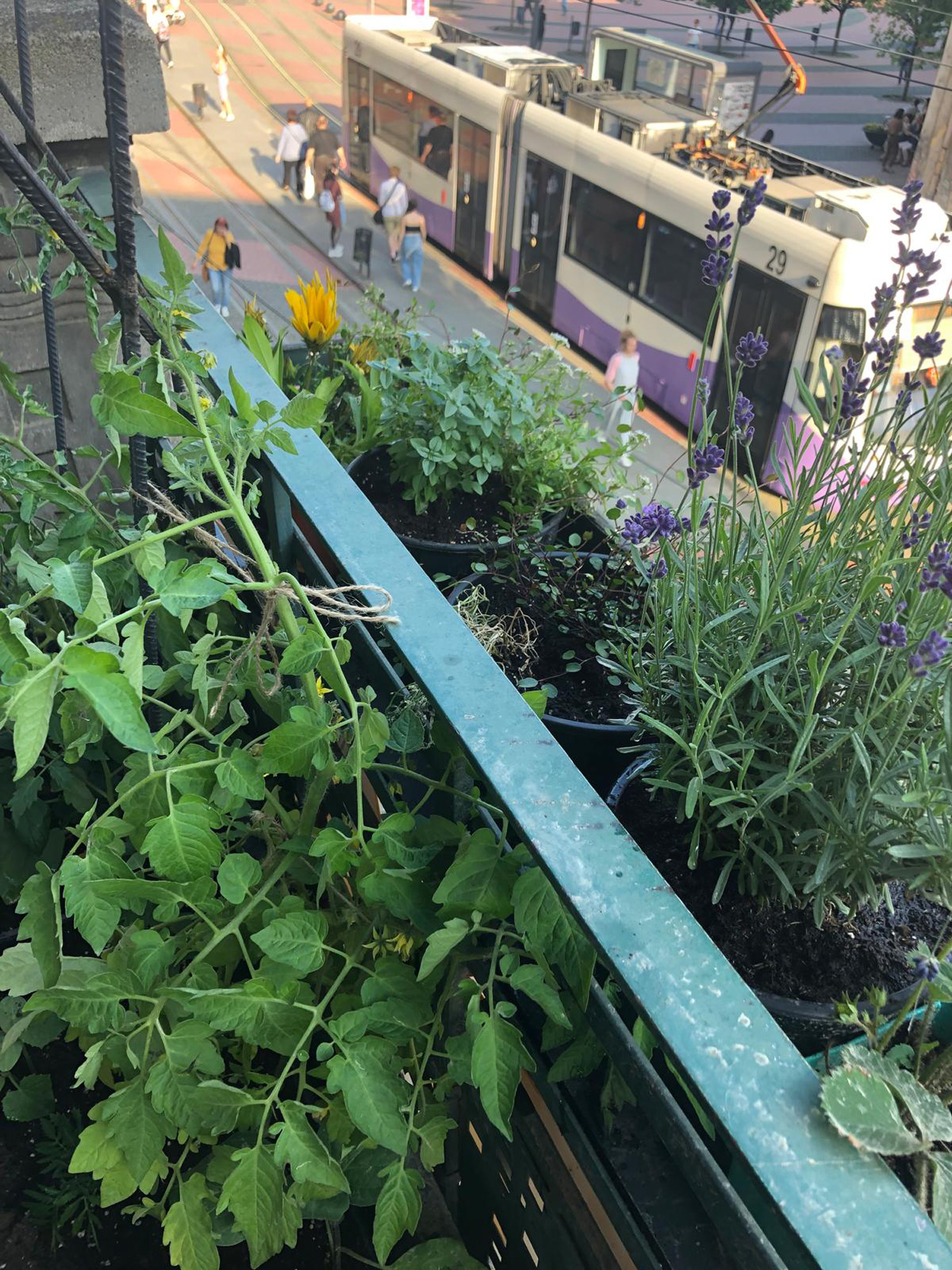
With the inauguration of the Minitremu (Un)Learning Center, I set up a small botanical sanctuary on the balcony, together with Bogdan Isopescu, Alex Ciobotă and Ciprian Homorodean. The concept behind this project was to create a collaborative microclimate in which each plant contributes to the growth and well-being of the others, and simultaneously a space to observe the socio-biological complexity in which plants co-exist.
The concern for plants and interspecies coexistence has appeared in the association’s practice since the first editions of the Minitremu Art Camp. In the second edition, Anca Benera and Arnold Estefan proposed the Herbarbarium workshop, in the form of a speculative exercise in botanical investigation, starting from European legislative norms regarding the eradication of alien species. The camp participants intuitively identified plants with a “foreign” appearance, pressed them in a herbarium and assigned them fictitious origins, descriptions and uses, the results being interpreted by the botanist Macalik Ernő.
In another edition, Raluca Voinea and Eduard Constantin proposed the Green Mars workshop, an exercise in collective imagination of survival scenarios in the face of climate collapse. One team developed solutions for living on an inhospitable Earth, and the other on Mars. The workshop included presentations on extinct species, on the alternatives proposed by the Transit Garden, and culminated in the creation of a common shelter/refuge, which showed that survival is only possible collectively and through cooperation.
The 8th edition of the camp was inaugurated by the exhibition Now, the impetus is to live! which brought together several practices of ecological regeneration, along with various forms of community organization: from alternative food circuits or local governance, to rural and urban models of coexistence in the context of the climate crisis. The exhibition was hosted by the Pavilion in the Children’s Park, and constituted the leitmotif of the camp, being activated by the invited artists through several workshops.
The Minitremu Garden is a continuation of these explorations and a way of overcoming a “plant blindness” that contemporary cities suffer from, in which the complex behaviors that plants possess are often reduced to simplistic terms such as – houseplant, ornamental or vegetable. (Beyond Plant Blindness, The Green Box, Berlin 2020).
Companion plants support each other, attract beneficial insects and participate in creating conditions for the growth of others. Life is sustained through diversity and interdependence.
Currently, the Minitremu Garden is expanding to GreenFeel Timișoara.
#heterotopia #collectivedevelopment.